
How Much Does a Loft Conversion Cost in Woking? | Local Builder’s Guide
In Woking, where property prices are among the highest in Surrey and the cost of moving up from a three bedroom to a four bedroom house involves stamp duty, fees, and upheaval that easily exceeds £30,000, converting the unused roof space above your ceiling makes substantially more financial sense than buying somewhere bigger. A loft conversion adds a genuine extra floor to your home, increases its market value in one of the South East’s strongest property markets, and delivers the bedroom, bathroom, or office your household needs without leaving the location, the schools, and the fast train into Waterloo that made you choose Woking in the first place.
But costs vary considerably depending on the type of conversion your roof requires, the size of the finished room, whether you include an ensuite, and the structural work involved. Woking’s housing stock adds its own considerations — the town’s mix of Victorian and Edwardian properties, inter-war and post-war housing, extensive Green Belt surroundings, and conservation area designations all influence what can be built and what it costs. This guide sets out realistic figures and helps you budget with confidence.
Velux Conversions
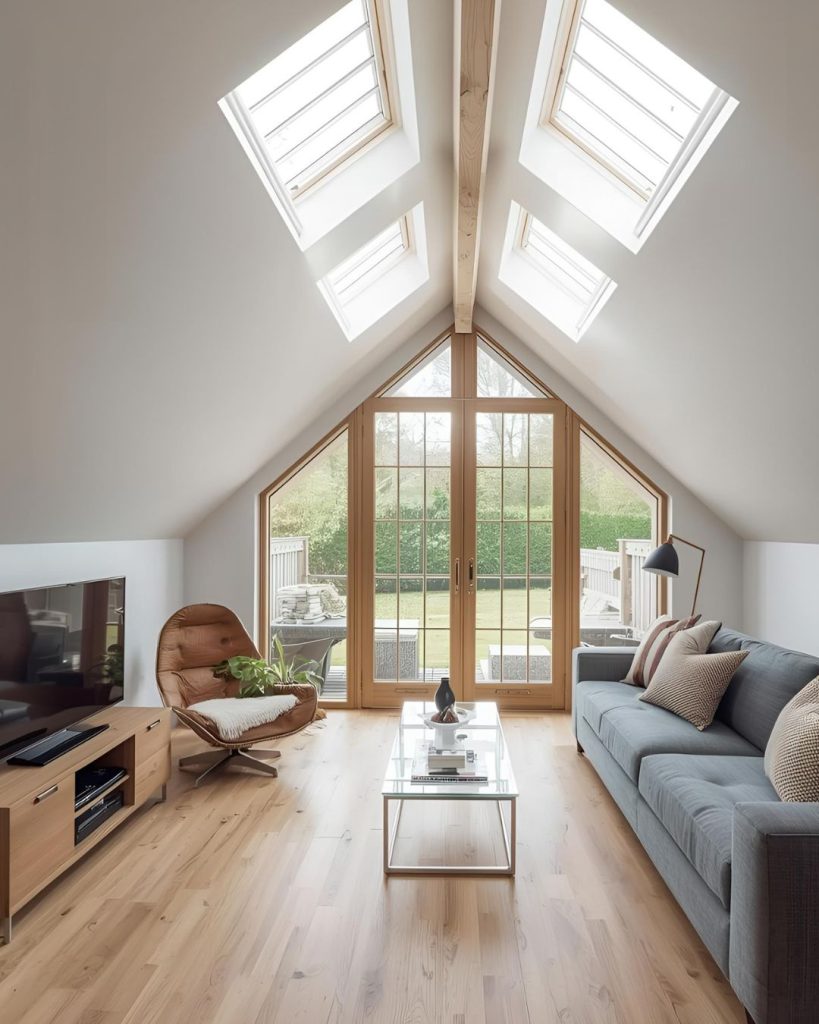
A Velux conversion is the simplest and most affordable option. The existing roof stays completely unchanged — no dormers, no gable extensions, no alteration to the external appearance. Natural light comes from Velux roof windows fitted into the existing slope, and the interior is fitted out with a strengthened floor, insulation, a new staircase, electrics, plastering, and decoration.
The essential requirement is adequate headroom — roughly 2.2 metres from the ceiling joists to the ridge. Many of Woking’s detached and larger semi-detached properties have sufficient height, particularly across the established housing in Hook Heath, Mount Hermon, St Johns, and the family homes through Barnsbury and Old Woking.
A Velux conversion in Woking typically costs between £22,000 and £36,000. A straightforward bedroom without an ensuite sits at the lower end. Adding an ensuite shower room, upgraded flooring, and higher specification finishing pushes toward the upper end. Without an ensuite, most Velux conversions locally fall between £22,000 and £29,000.
The advantages are cost and speed — a Velux is the cheapest conversion type and typically completes in four to six weeks. It is also the least visually intrusive option, which matters in Woking where conservation area coverage across parts of the town centre and surrounding areas means changes to rooflines face closer planning scrutiny. Since a Velux conversion does not alter the roof shape, it encounters fewer constraints than a dormer.
The limitation is usable space. The sloping ceiling on both sides means full standing height only exists near the ridge, tapering toward the eaves. For a bedroom this works perfectly — beds do not need full ceiling height. For a room that needs consistent headroom throughout with space for furniture against every wall, a dormer delivers a better result.
Rear Dormer Conversions
A rear dormer extends the roof outward at the back of the property, creating a flat-roofed structure that dramatically increases both usable floor area and headroom. Where a Velux confines you to the space under the slope, a dormer provides vertical walls and a flat ceiling — making the room feel like a genuine additional storey rather than a converted attic.
Full-width rear dormers are the most popular option across Woking because they transform the entire loft into one spacious room with consistent headroom throughout — genuinely comparable to the bedrooms on the floor below.
A rear dormer conversion in Woking typically costs between £32,000 and £54,000. A modest dormer covering part of the rear roof with a simple bedroom sits at the lower end. A full-width dormer creating a spacious master suite with a well-specified ensuite bathroom reaches the upper end. Most three bedroom semis across Woking converting with a rear dormer and ensuite fall between £38,000 and £52,000. The slightly higher cost bracket compared to some neighbouring towns reflects Woking’s premium labour market and the higher specification expectations that come with the area’s property values.
Most rear dormers proceed under permitted development without planning permission, provided the volume does not exceed 40 cubic metres for terraced houses or 50 cubic metres for detached and semi-detached properties, the materials match the existing roof, and the dormer does not extend beyond the plane of the roof slope facing the highway. However, Woking has conservation area coverage across parts of the town centre and surrounding areas — properties within these designations face tighter restrictions and a dormer visible from a public highway or footpath may require planning permission from Woking Borough Council.
Hip-to-Gable Conversions
Many of Woking’s semi-detached houses — particularly the inter-war and post-war housing across Horsell, Sheerwater, Maybury, and the established streets around Woking Park — have hipped roofs where the side slopes inward rather than meeting a vertical gable wall. This hip significantly reduces the usable loft space because the sloping side eats into the floor area on one side.
A hip-to-gable conversion extends the side wall vertically to the ridge line, replacing the sloping hip with a flat gable end and reclaiming the space that was previously wasted. Combined with a rear dormer — the most popular configuration across Woking — the gable provides full headroom across the width while the dormer extends the depth, creating the most spacious possible conversion.
A hip-to-gable on its own typically costs between £34,000 and £52,000. Combined with a full-width rear dormer, costs usually fall between £44,000 and £62,000. The additional structural work to rebuild the side wall and modify the roof structure adds cost compared to a simple dormer, but the space gained is substantially greater — often large enough for a generous master bedroom, a well-proportioned ensuite bathroom, built-in wardrobes, and dedicated storage along the remaining eaves.
The hip-to-gable with dormer combination is particularly popular across Woking because the inter-war semis that dominate many residential streets were built with hipped roofs as standard. The conversion transforms a property with a cramped, unusable loft into one with a spacious fourth bedroom and ensuite that fundamentally changes both how the house works and what it is worth in Woking’s competitive market.
What’s Included in These Costs?
A comprehensive quote should cover every element needed to deliver a finished room. Understanding what is included helps you compare quotes fairly.
Structural work — upgrading ceiling joists to habitable floor loading, steel beams supporting the modified roof structure, and party wall fire-stopping between semi-detached or terraced properties.
The staircase connecting the new room to the existing landing. Building Regulations require a permanent fixed staircase. The design needs to fit the available space without compromising existing bedrooms. Typically £2,000 to £4,000 within the overall quote.
Insulation to current Building Regulations throughout roof slopes, dormer walls, gable ends, and any other external surfaces. Modern thermal requirements are substantially higher than many homeowners expect, ensuring comfortable year-round temperature.
Electrics — lighting circuits, socket positions planned for the intended use, smoke detection integrated with the existing system, and any dedicated circuits for bathroom fixtures.
Plumbing if the conversion includes an ensuite — supply pipes, waste connections, and the soil stack connection for toilet and shower waste. The soil stack route is the critical element — confirming adequate fall from the loft to the existing drainage before construction begins prevents expensive discoveries mid-build.
Plastering, flooring, and decoration complete the interior. Building control fees cover inspections during construction, typically £400 to £700.
What Affects the Cost?
Roof construction type has the biggest impact. Traditional cut roofs with rafters and purlins — common in Woking’s older Victorian and Edwardian properties and inter-war housing — leave more open space and need less modification. Modern trussed roofs on properties built from the 1960s onward use interlocking trusses that fill the void and require significant steelwork. The later housing across Sheerwater, Maybury, and the newer developments commonly has trussed roofs that add cost.
Ensuite specification is the most controllable variable. A basic shower room adds £3,500 to £5,500. A higher specification ensuite with a frameless walk-in shower, large-format tiles, quality fittings, underfloor heating, and a heated towel rail pushes £6,000 to £12,000. In Woking’s premium market, homeowners tend to invest at the upper end of the ensuite specification because the property values support and reward higher quality finishing.
Conservation area restrictions affect properties across parts of Woking. A dormer visible from a public vantage point within a conservation area may require planning permission. Planning applications add eight to twelve weeks and introduce uncertainty, though well-designed proposals typically receive approval. A pre-application enquiry with Woking Borough Council gives an informal view before committing to design work. A Velux conversion faces fewer constraints since it does not alter the roofline.
Party wall agreements apply to semi-detached and terraced properties. Surveyor fees run £700 to £1,500 per neighbour. The statutory notice period is two months — start early in the planning process.
Access and scaffolding affect costs depending on the property. Most dormer and hip-to-gable conversions require scaffolding. Properties on tighter streets, those backing onto the Basingstoke Canal, or those with restricted rear access may incur higher scaffolding charges.
Property age and construction influence the work involved. Woking’s housing spans Victorian properties in the town centre, Edwardian housing through Old Woking, inter-war estates, post-war developments, and modern builds. Each era presents different structural arrangements, different roof constructions, and different challenges. The structural assessment at the outset identifies what the specific property needs.
Does It Add Value?
A loft conversion consistently adds more value than it costs. In Woking’s strong Surrey property market, converting a three bedroom house into a four bedroom property with an ensuite shifts the home into a market bracket where the premium is significant. Estate agents across Woking typically value the additional bedroom and bathroom at £35,000 to £60,000 depending on the property and location — with properties in Hook Heath, Mount Hermon, and the premium streets around the town centre commanding the highest uplift.
The practical value is equally important. An extra bedroom relieves pressure on existing rooms. An ensuite frees up the family bathroom. A dedicated office in the loft creates genuine separation from household activity — particularly relevant for Woking’s substantial commuter population where hybrid working means spending two or three days per week at home. With trains into London Waterloo taking just twenty-four minutes, Woking attracts professionals who value both the commute and the space to work from home effectively. A loft conversion delivers both.
Getting the Best Value
Get detailed quotes from two or three experienced builders covering the same scope — structural work, staircase, insulation, electrics, plumbing if applicable, plastering, flooring, decoration, and building control fees. Without consistent scope, comparing prices is meaningless.
Finalise your ensuite specification before requesting quotes. The difference between a basic shower room and a premium bathroom runs to several thousand pounds. Builders quoting different specifications produce prices that cannot be meaningfully compared.
Prioritise the structural fundamentals — quality steelwork, strengthened floors, thorough insulation, and compliant fire protection. These support everything else for decades. Decoration and fixtures are straightforward to upgrade later.
Check the conservation area position for your Woking property before committing to a design. A builder experienced with local loft conversions should advise on the likely planning position at the initial assessment stage.
If you are considering a loft conversion at your Woking home, get in touch for a free assessment. We will inspect your roof space, discuss your options, check the planning position, and provide a clear quote so you know exactly what is involved before you commit.